Most fitness apps solve one part of the problem. One holds your workout plan, another records food, and an AI chatbot offers advice without knowing what you actually did.
We built NSO Fit around a more useful idea: planning, training, nutrition, goals, and coaching should form one connected loop.
Plan → Train → Log → Eat → Measure → Review → Adjust
An athlete can build a reusable workout plan, complete it as a checklist, log the food they eat, track goals and body measurements, and then ask an AI coach to explain the overall trajectory.
The important difference is that the coach works from confirmed application data—not guesses.
From a plan to a completed workout
NSO Fit lets the athlete create a reusable plan from an exercise catalog and set how often it should be performed. When it is time to train, that plan opens as a checklist.
Each exercise displays the fields that make sense for it. Strength exercises can record sets, repetitions, and weight. Cardio can capture duration, distance, heart rate, and calories. Previous results can prefill the form to reduce repetitive entry, while every value remains editable.
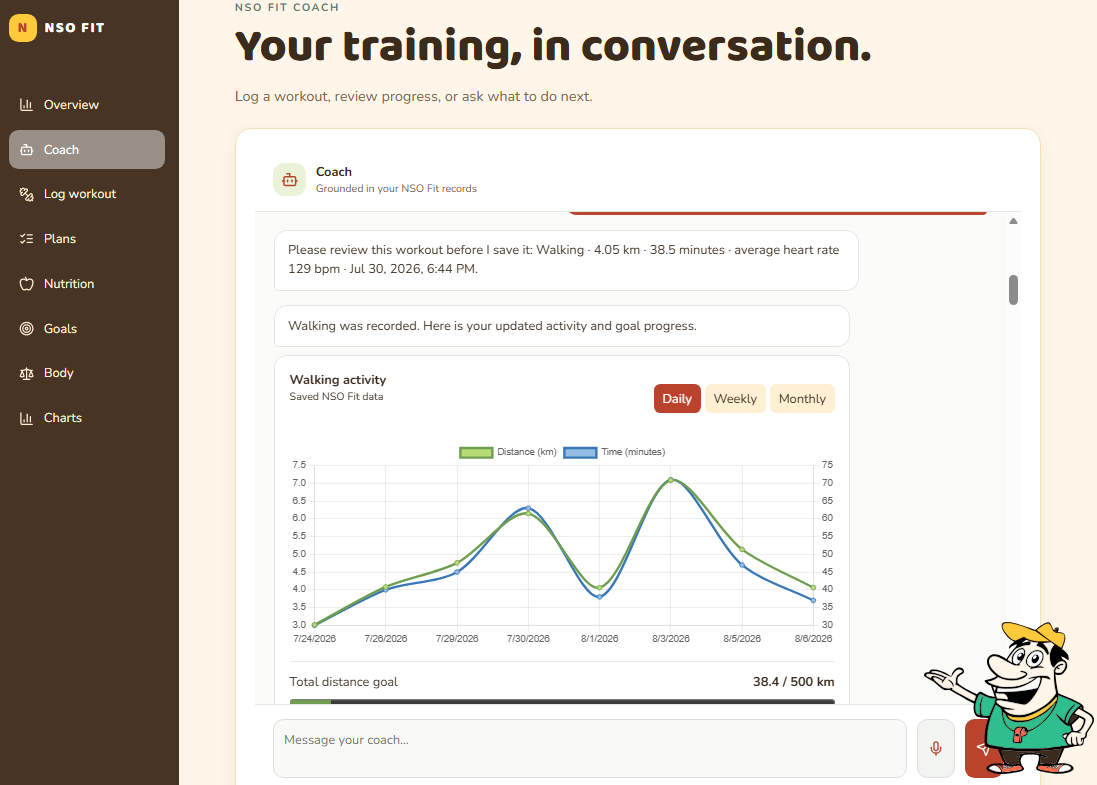
Workout logging is also conversational. An athlete can type or dictate:
I just completed a 10k run in 55 minutes. My average heart rate was 120 bpm.
NSO Fit converts that sentence into structured workout information and shows it for review. Nothing is saved until the athlete confirms it.
Making food logging faster
Food logging often fails because it feels like data entry. We wanted the experience to begin with ordinary language:
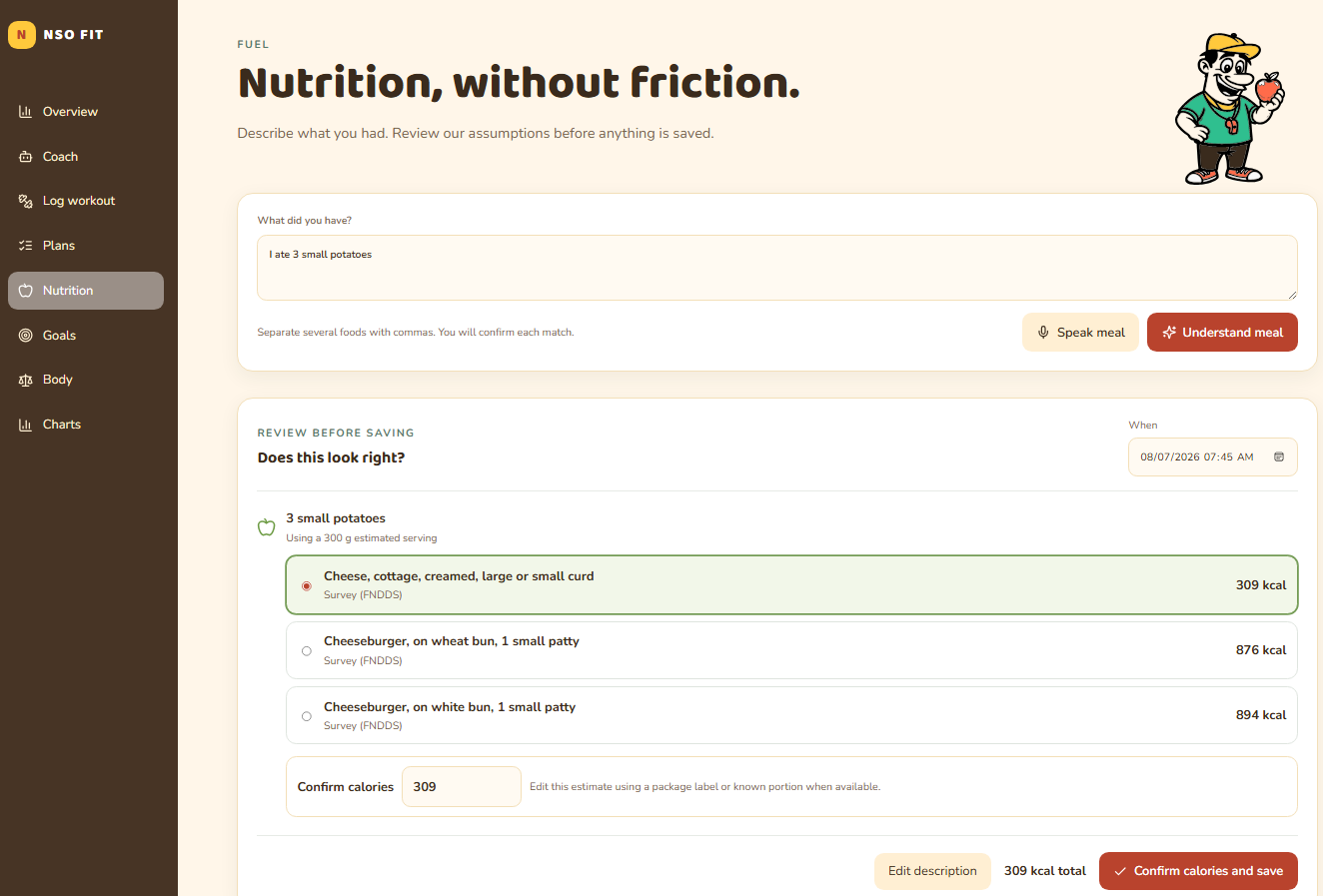
I had a small piece of salmon, three small boiled potatoes with butter, some salad, and a small slice of New York cheesecake with two strawberries.
The description can be typed or entered with the Speak meal button. Speech appears in the text box and remains editable before the app does anything with it.
Azure OpenAI helps separate the sentence into meaningful food phrases while preserving quantities, sizes, and preparation details. For example, it can keep “three boiled potatoes with butter” together while separating “two strawberries” from the cheesecake.
If AI is unavailable, a deterministic parser takes over so meal logging can continue.
Connecting to USDA FoodData Central
The food API is USDA FoodData Central, often shortened to FDC.
Once the meal has been separated into foods, NSO Fit searches previously used and cached matches first, then queries FoodData Central when necessary. The API provides nutrition records for common foods, general ingredients, and branded products.
The application scales nutrient values to the estimated serving weight and shows up to three likely matches. Every selected item includes an editable calorie value, and the athlete confirms the final meal total before saving.
This distinction matters: AI understands the sentence, USDA supplies the nutrition data, and the athlete confirms what becomes part of the record.
A phrase such as “three small potatoes” will never be perfectly precise. The potatoes may vary in size, and the amount of butter may be unknown. Rather than hiding that uncertainty, NSO Fit displays its serving assumption and lets the athlete correct it.
Turning records into an AI progress summary
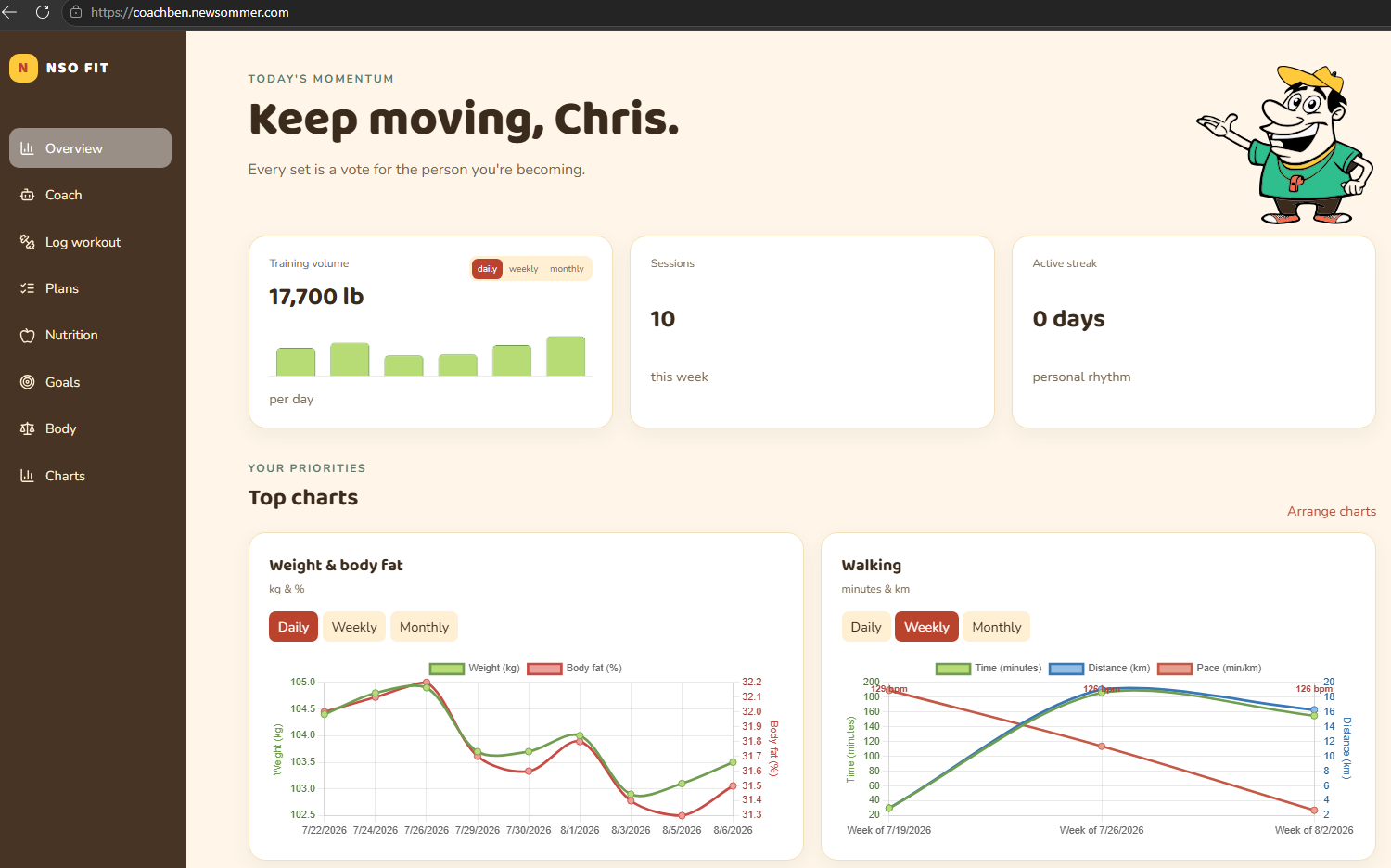
NSO Fit also tracks goals, weight and body-fat measurements, workout history, and progress charts. These records give the AI coach the context that a generic chatbot normally lacks.
When an athlete requests a progress summary, the server gathers relevant, verified facts such as:
- Completed workouts and active training days
- Duration, distance, heart rate, and strength volume
- Active goals and workout plans
- Weight and body-composition trends
- Confirmed meals and nutrition coverage
- Recorded daily energy data
The Azure OpenAI coach can then explain what happened during a requested period, compare it with the preceding period, identify positive or negative trends, and recommend one or two realistic next actions.
The model is instructed to treat NSO Fit records as the source of truth. It must label assumptions, acknowledge missing data, avoid inventing personal measurements, and avoid medical diagnosis or treatment. If the model cannot be reached, the app returns a limited summary built deterministically from verified records.
AI for understanding, application code for authority
One of our main design principles is to separate intelligence from authority.
AI is useful for understanding natural language, identifying intent, explaining patterns, and making data approachable. Application code remains responsible for permissions, database queries, calculations, validation, and storage.
A workout mentioned in conversation is proposed for review, not quietly saved. A meal is matched against FoodData Central and confirmed item by item. Model output is never treated as a shortcut around validation.
Voice follows the same principle. Speaking makes entry faster, but finishing a sentence is not consent to save it.
The complete loop
NSO Fit is not simply a workout logger, nutrition lookup, or AI chat screen. Its value comes from connecting them:
- Build a workout plan.
- Complete and log the workout.
- Speak or type what you ate.
- Review and confirm grounded nutrition matches.
- Track goals and body changes.
- Ask the AI coach to summarize the confirmed history.
- Use that summary to choose the next action.
The AI becomes more useful as the underlying records become more complete. The records become easier to maintain because voice and natural language reduce the effort required to create them.
That is what we are building with NSO Fit: easy to use at the moment of action, careful about what becomes a fact, and intelligent when it is time to understand the bigger picture.